Humanness. Evolution. Communication.

Exploring what becomes possible when we bring more of our human capacity into learning, work and life.
Educator • Mentor • Cultivating Identity, Purpose and Connection
Taija Townsend
Logo design, photographs and heart-shaped pepper by my sister ©Riikka Townsend
Why humanness?
As an educator, I focus on humanness. My fascination with people stems from both my professional background and my personal journey of growth, which has drawn me into exploring the more deeper levels of what it means to be human. I’ve been bridging these two sides of myself in my teaching work for more than a decade with the intention to support the young in discovering their human capacity.

We cannot always predict or standardise the shape that development will take. Each person has their own capacity, rhythm and direction of growth. For me, education is about creating the conditions in which that individual evolution can happen.
This heart-shaped pepper grew unexpectedly in my sister's garden –
a small reminder that growth has its own ways of surprising us.
EVOLUTION
Why communication?
In my role, I am in a position to create an impact, and communication is where I have chosen to place my attention. With communication, so much is at stake. For this reason, I want to be available to those I teach and help them in any way I can. For me, this begins with being truly present to the person in front of me.


Learning as
an ongoing
dialogue
Communication is not just a dialogue with others. It is also a dialogue with the self.


There is an endless flow and movement between these two dialogues, much like the two paths of the infinity symbol, continually meeting, flowing apart and returning to one another.
This is also why conversation, feedback and presence are vital between educators and learners. Learning is not simply the transfer of knowledge from one person to another; it is a shared process of growth.
Thoughts on Education, Teaching and Learning
BEYOND PERFORMANCE
How students understand and experience effort in learning.
If we expect students to be active participants in their own learning, the educational dilemma isn't simply whether effort should be rewarded, but whether our assessment systems adequately recognise the forms of engagement through which learning occurs. This doesn't mean abandoning standards or replacing achievement with effort. Rather, it means acknowledging that education isn't simply the production of measurable outcomes but a relationship with the self in which students actively participate in becoming.

Photograph by ©Rewan Marouf

What happens when we learn together?
Selected reflections from people I've taught, mentored and worked with.
“Dear Professor Taija, I hope this message finds you well. I wanted to take a moment to share my thoughts after attending the initial session of the Team Communication Skills course. If I were aspiring to pursue further studies in language, culture, or sociology, I would undoubtedly be thrilled to encounter a professor like you. Your passion for exploring deeper layers of communication and team dynamics is inspiring.”
Xi, Master's student (Finance) at Hanken School of Economics
Want to know more about my work?
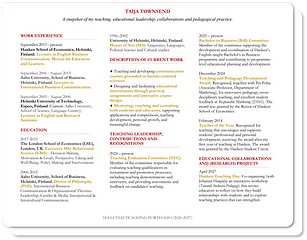
My pedagogy has developed at the intersection of teaching, project work and my own ongoing exploration of what it means to be human. This portfolio offers a snapshot of my teaching, educational leadership, collaborations and pedagogical practice.